Quotation Platform
When you build software for real business operations, the hardest problem is rarely the interface. It is often the invisible complexity behind it: organizing customer data, validating quote states, keeping records consistent, and making sure operations can scale without losing trust.
This project started as a focused effort to solve that exact problem: create a system that enables a business to manage clients, generate quotations, export them as professional PDF documents, and maintain a clean multi-tenant workflow without the overhead of a heavy enterprise stack.
The platform is designed to feel like a modern quotation system: simple enough for everyday business use, but structured enough to support real operational workflows, validation, and professional document generation.
The problem
Most small and medium operations still handle quotation management with fragmented tools. Different spreadsheets, email chains, repeated manual calculations, and inconsistent tracking lead to:
- duplicated client information
- inconsistent tax and pricing logic
- delays in generating quote documents
- poor visibility into quote status
- difficult collaboration across users and business units
- limited portability when a team needs to move from local tools to a cloud setup
For a business that depends on customer quotes, those issues compound quickly. A quote is not just a document; it represents a commercial offer, an operational commitment, and sometimes the first step toward revenue.
The real challenge was not to build a pretty dashboard. It was to build a reliable business workflow that could handle records, validation, and document generation in a scalable and maintainable way.
The approach
I approached the project as a practical systems design problem.
Instead of blindly adding features, I focused on a few core principles:
- Keep the application simple to use.
- Separate business logic from presentation.
- Secure every tenant-scoped operation.
- Make it easy to render documents consistently.
- Use a stack that is light, portable, and modern.
The result is a quote management system with a tenant-aware architecture, a clean API layer, client and quote management, and PDF generation workflows that can be used directly from the app.
Architecture and core workflow
The project is structured around a modern frontend and a server-side API runtime that handles business data operations.
Frontend
The web app is a React + TypeScript interface powered by Vite. The UI uses a clean component system and a design language from shadcn/ui, with Tailwind for styling. It includes:
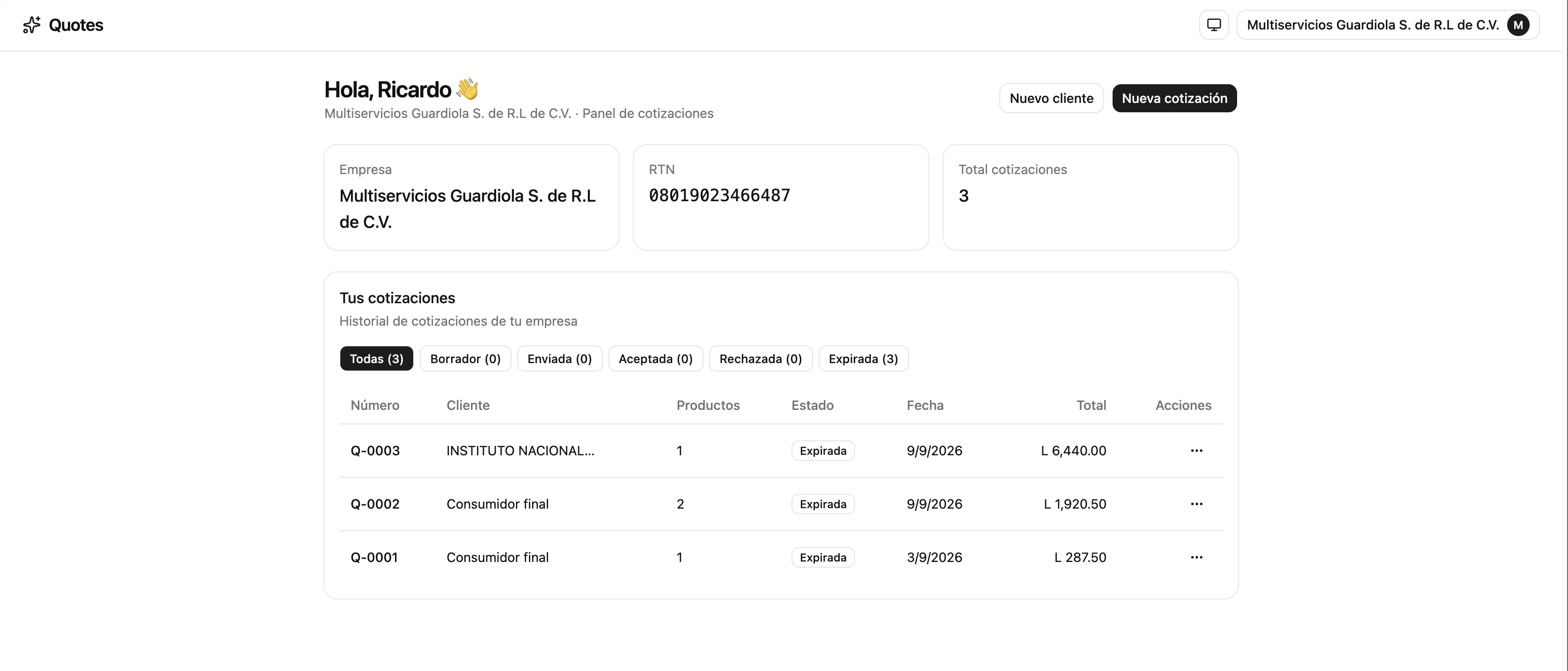
- dashboard overview
- client management
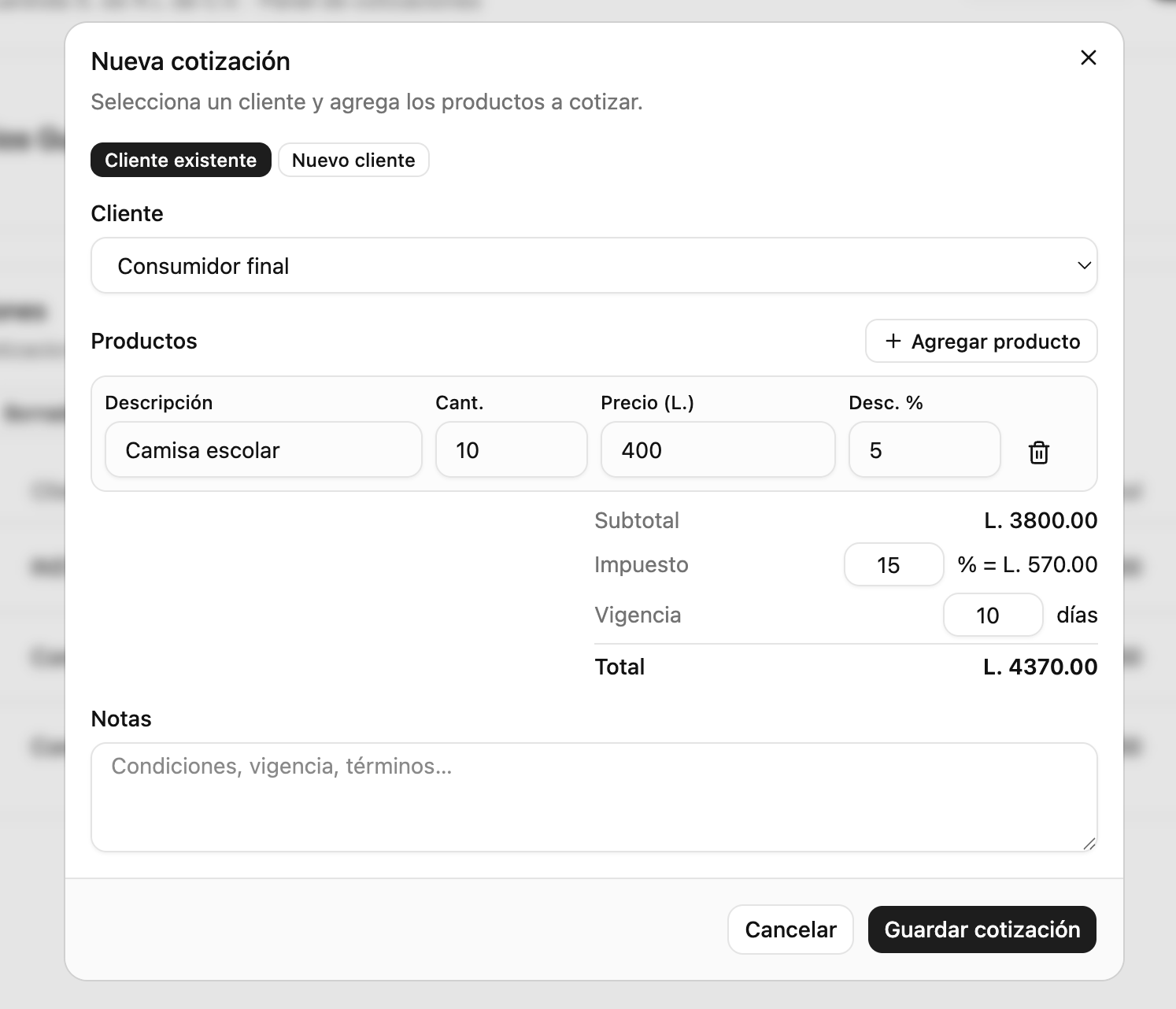
- quote creation and editing
- status transitions for quotes
- PDF export
- tenant configuration
- authentication flow
This makes the app responsive and familiar for modern web users while keeping the codebase maintainable.
API layer
The backend is built with Hono, a lightweight web framework designed for edge-style runtimes and APIs. It exposes routes for:
- authentication
- tenant access
- quote operations
- client operations
The application follows a clear pattern where every request is checked against the active tenant context, ensuring access is controlled properly.
Persistence and data model
Data is modeled with Drizzle ORM and SQLite, which makes the project lightweight and easy to reason about while still giving a strong schema definition approach. The schema covers:
- users and authentication records
- companies and tenants
- client records
- layouts and templates
- quotes and quote lines
- tenant settings
This is a strong fit for an app that does not need the complexity of a large distributed database, but still benefits from a real relational schema and type-safe data access.
Cloud runtime
The project is designed for a serverless and edge-friendly environment through Cloudflare Workers. That gives a strong combination of:
- low operational overhead
- global distribution
- fast deployment cycles
- integrated environment-friendly hosting for APIs and app assets
By running the app on Workers, the system can stay lean while still being production-friendly for small business use cases.
The key problem solved: operational consistency
The central challenge was not creating one feature. It was creating a consistent operational system where business rules stay in place.
A few examples:
- quote numbers must be unique within a tenant
- client data must stay associated to the correct company
- quote totals and taxes must be recalculated correctly when line items change
- status transitions such as draft, sent, accepted, rejected, and expired must stay coherent
- tenant configuration must not leak across users
This is where a proper system design pays off. The app does not treat quotes as isolated UI records. Instead, it respects ownership, lifecycle, and validation boundaries.
The backend validates incoming payloads, computes subtotal and tax values consistently, and handles automatic expiration logic for quotes past their validity date. That gives the project stability beyond a simple CRUD interface.
PDF generation and business value
One of the standout features is that a quotation is not only stored, but can also be exported as a professional PDF. The PDF generation is handled through pdf-lib and a custom document layout that includes:
- company identity and contact data
- client information
- quote metadata
- itemized product rows
- tax and totals
- final company branding
This turns the app from a small internal manager into an operational tool that directly produces customer-facing documents.
In business terms, this means less manual work, less sending of ad hoc files, and more consistency in how quotations are presented.
Authentication and tenant model
A critical part of the system is the auth and tenant architecture.
The project uses Better Auth for user authentication and then binds each authenticated user to a tenant/company model. This allows correct scoping across the app, meaning the current user only sees and modifies their relevant company data.
This is important because a multi-tenant application cannot rely on frontend-only checks. The real guarantee must live in the backend, and this project enforces that access pattern explicitly.
Why this stack
I chose this stack intentionally:
- React + TypeScript: predictable UI development and great tooling
- Vite: fast developer experience and simple build pipeline
- Hono: lightweight API routing and edge-friendly structure
- Drizzle ORM: typed SQL access with a clean model layer
- SQLite / D1-friendly schema: good balance between simplicity and structure
- Cloudflare Workers: modern deployment model with low operational complexity
- shadcn/ui + Tailwind: production-friendly interface styling
- pdf-lib: practical PDF generation without heavy enterprise tooling
- Better Auth: secure authentication integrated into the app without custom boilerplate chaos
This stack is not over-engineered, but it is modern enough to support the real requirements of a serviceable business system.
What I learned
The biggest lesson from this project is that a seemingly small business workflow can become a full system when you account for the details:
- user ownership
- validation
- business states
- PDF generation
- tenant boundaries
- data consistency
What looks like a quote tool at first is really a workflow engine for commercial operations.
That is why the project is valuable: it solves the boring but critical parts of running a business. It reduces friction, keeps records structured, and makes customer-facing documents easier to generate and trust.
Final reflection
This quotation platform is a practical example of how a small software product can be built around a clear business problem, not just a generic dashboard.
It combines modern frontend patterns, a strong backend model, and a cloud-native runtime to create a quote management system that is simple to use but powerful enough to handle real-world operational needs.
The project is less about showing off a complicated stack and more about proving that the right architecture can turn a manual process into a reliable product.
That is the real win.
Screen shots